


FASTENER BUYING MADE SIMPLE:
Identifying the Right Blind Rivets for Your Application
This guide will help you understand the various Blind Rivets that we carry, and their functions. The guide also contains information on the naming structure used for blind rivets to help you navigate the complex nomenclature used in their product descriptions.
Blind Rivets are a unique fastener type which are installed with a handheld mechanical or hydraulic tool called a rivet gun. A rivet is placed in the gun, then inserted into a hole that is matched up in two or more pieces of material. Once inserted, pulling the trigger of the rivet gun pulls out the rivet pin causing the back end of the rivet to expand, pulling the materials tightly together. The front end will have only the smooth head of the rivet exposed, while the back, or “blind” side will hide the expanded, and misshapen, portion of the rivet.
Principal factors in purchasing rivets are the size of the hole (will equal the rivet diameter) that is being used and the total thickness of the materials that are being riveted together (known as the “grip range” when determining the correct rivet for the job). Barrel length is also sometimes noted in a rivet’s description.
RIVET DIAMETER
This is the diameter of the rivet body, or the portion that will be inserted into the parts which you are attaching together. If your parts have pre-drilled holes, you will need to measure them. If you are drilling the holes yourself, you can choose an appropriate size for your drill bit and for your rivet diameter.
GRIP RANGE
A rivet’s grip range is the range of material thicknesses that it can efficiently hold together. If you use a rivet with a grip range that is too small, it won’t be able to properly expand on the “blind side”. If you use a rivet with a grip range that is too large, the back will expand, but not enough to hold the two pieces together tightly.
To find the grip range that you require, you’ll need to measure the thickness of each piece you’re attaching, add them together, and calculate them to a decimal point of 1/100th of an inch. If you’re riveting a 1/8” piece of sheet metal to a 3/16” piece of sheet metal, your total thickness is 5/16”, or .3125”.
• A rivet with a grip range of .25-.31 would be slightly too small.
• A rivet with a grip range of .31-.37 would be in range, but very close to the bottom end of the range.
• Your best option would be to choose a rivet with a grip range that leaves some room on either side of your material thickness, such as a grip range of .25-.37.
BARREL LENGTH
Barrel length is the length of the rivet body before installation. However, it is less reliable than grip range for sizing rivets because rivets with the same grip range can have different barrel lengths, and rivets with the same barrel length may have different grip ranges. For that reason, we recommend using grip range when selecting blind rivets.
BLIND RIVETS
Optional head styles are offered for different front-facing appearances and requirements. They include:
STANDARD DOME HEAD BLIND RIVETS
Standard Dome Head Blind Rivets are the most common style. Final installation results in a dome-shaped, slightly rounded head with a hole in the middle on the front facing side.
Example of a Standard Dome Blind Rivet description:
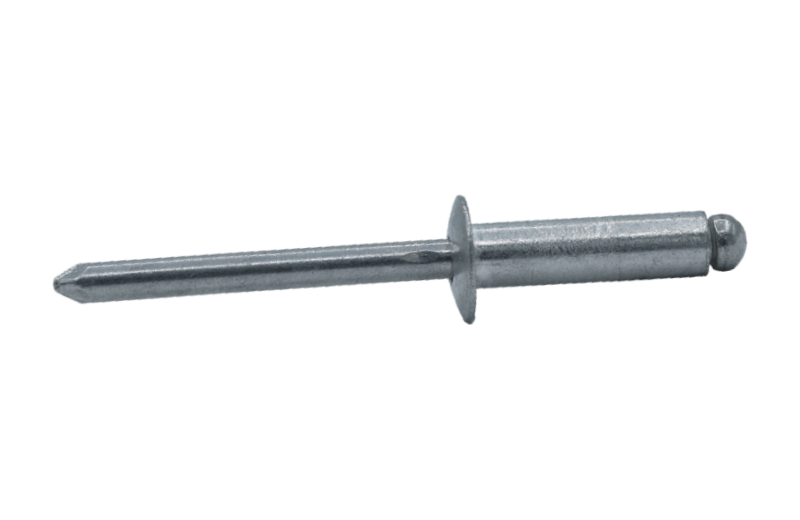
On this part, the 1/8” is the diameter of the body of the rivet being installed into the hole. .02”-.06” is the grip range, or range of material thicknesses that this rivet can cover. #41 is another method of noting rivet size, combining the rivet diameter and grip range. It is a standard blind rivet, meaning it has a dome shaped head. It has an aluminum body and a steel mandrel (the part that is removed during installation). It has a barrel length of .212”.
LARGE FLANGE BLIND RIVETS
Large Flange Blind Rivets are also dome shaped but used for oversized or imperfect hole shapes to allow for a bearing surface that is twice as wide and full coverage of the hole into which it was installed.
Example of a Large Flange Blind Rivet description:
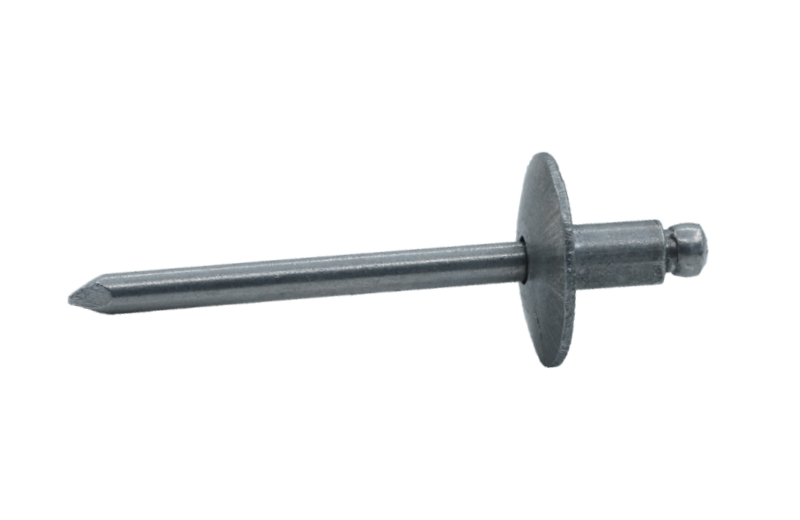
On this part, the 3/16” is the diameter of the body of the rivet being installed into the hole. .50”-.62” is the grip range, or range of material thicknesses that this rivet can cover. #610 is another method of noting rivet size, combining the rivet diameter and grip range. It is a large flange blind rivet, meaning it has a dome shaped head with a wider flange to distribute the load over a larger surface area. It has an aluminum body and an aluminum mandrel (the part that is removed during installation). It has a maximum barrel length of .825”.
COUNTERSUNK HEAD BLIND RIVETS
The head shape of a Countersunk Head Blind Rivet allows the rivet to sink further into the materials creating a flush installation with a lower profile.
Example of a Countersunk Head Blind Rivet description:
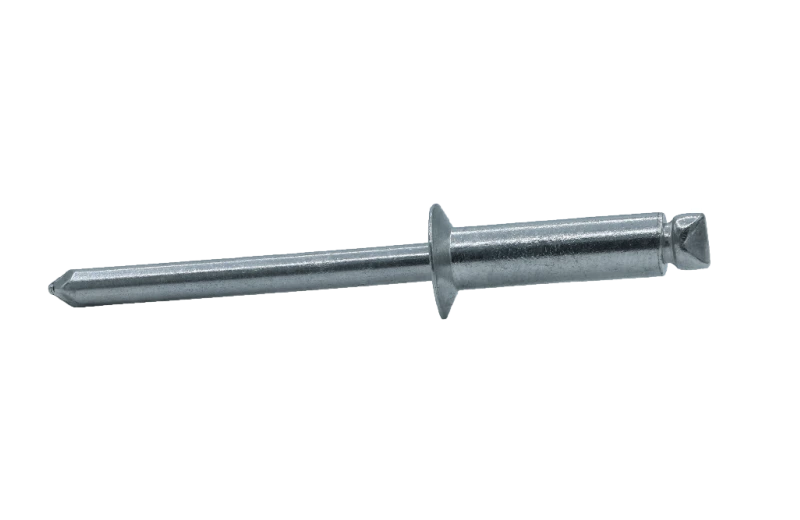
On this part, the 1/8” is the diameter of the body of the rivet being installed into the hole. .06”-.12” is the grip range, or range of material thicknesses that this rivet can cover. #42 is another method of noting rivet size, combining the rivet diameter and grip range. It is a countersunk blind rivet, meaning it has a flat shaped head designed to sit flush with the material surface. It has a steel body and a steel mandrel (the part that is removed during installation). It has a zinc finish and a barrel length of .275”.
CLOSED END BLIND RIVETS
The most common in dome shape with some countersunk options, Closed End Blind Rivets leave part of the mandrel inside the rivet while cutting off the rest, providing a sealed, closed end.
Example of a Closed End Blind Rivet description:
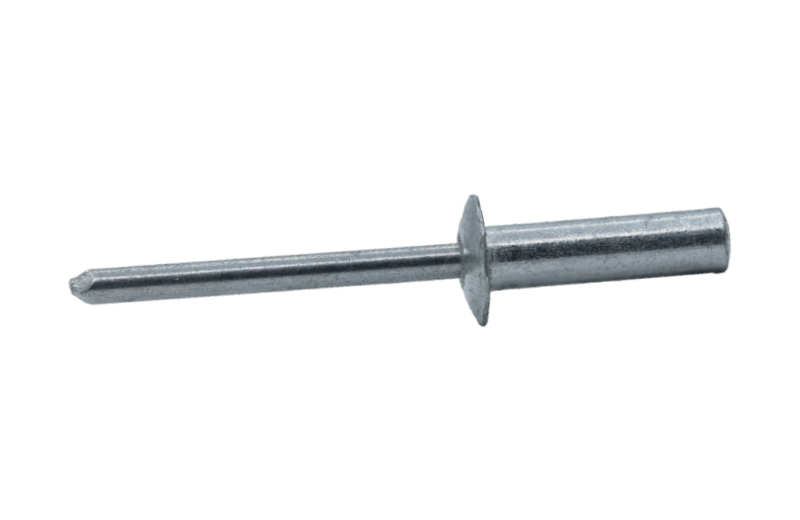
On this part, the 1/8” is the diameter of the body of the rivet being installed into the hole. .18”-.25” is the grip range, or range of material thicknesses that this rivet can cover. #44 is another method of noting rivet size, combining the rivet diameter and grip range. It is a closed end blind rivet, meaning it has a dome shaped head and a sealed end designed to help prevent moisture and air from passing through the installation hole. It has a stainless steel body and a stainless steel mandrel (the part used to set the rivet during installation). It has a barrel length of .440”.
If you have additional questions about blind rivets, we’d love to be a resource for you. Contact us at sales@fastenersuperstore.com, give us a call at (866) 688-2500 or use our live online chat in the upper right corner of this page!